
Simple Outside, Vast Inside
Emily Dickinson and Me

Joy Ribar is the author of the Deep Lakes and the Bay Browning series of cozy mysteries. You can find out more about her on the Blackbird Writers site, and buy her books on the site, too.
I missed teaching literature. Missed the rich discussions with high schoolers who encountered classical authors and poets for the first time. I missed watching their faces, eyes wide open, jaws dropped, when they discovered meaningful connections between literature and life. I could see how their inner world opened up, budding into new insights.
My longing to reunite with literature led to the creation of the Bay Browning mystery series, in which Bay’s well-contained outer world tumbles into chaos when murder comes calling.
The orderly life of the English professor collides with the rocky life of her sister, Cassandra, an ex-con with psychic abilities. Motives for murder intersect with literary themes and sisterly disorder. Order vs. disorder - a perfect entry point into the world of mysteries.
Poetry Slammed, book three, features a newly discovered Emily Dickinson poem and letter. Both debut in a performance at a college poetry open mic, hosted by Bay’s colleague, Vivian Rossi, the discoverer of the poem and letter.
I chose Emily Dickinson because she was prolific, familiar to the general public, an American enigma. What better showcase for a mystery than a poet whose poems still intrigue and confuse, while celebrating emotions and profound thoughts. When I began adding flesh to the bones of Vivian Rossi’s character, the path led straight to Dickinson, a kindred spirit in Vivian’s mind.
I often find that poets stand out from other authors in conveying a story in its most concentrated form. What many authors share in eighty-thousand words, some of the best poets condense into twenty or so lines. Many a poem is the byproduct of suffering, hardship, or affliction, and the intensity of that experience is enough to occupy a small space.
Vivian and Dickinson harbor secrets, including a private pain they carry throughout life. This parallel and the eccentricities shared by Vivian and the poet are highlighted in the mystery, so I wanted to understand Dickinson better.
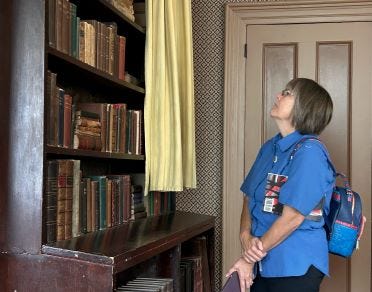
After getting reacquainted with some thematic poems and her mysterious “Master” letters, I knew a visit to Emily’s house, The Homestead in Amherst, Massachusetts, was a must. Perusing the homestead’s library of first editions made me yearn to linger there, touch the spines of the books, tenderly open their pages, and soak in the enlightening texts.
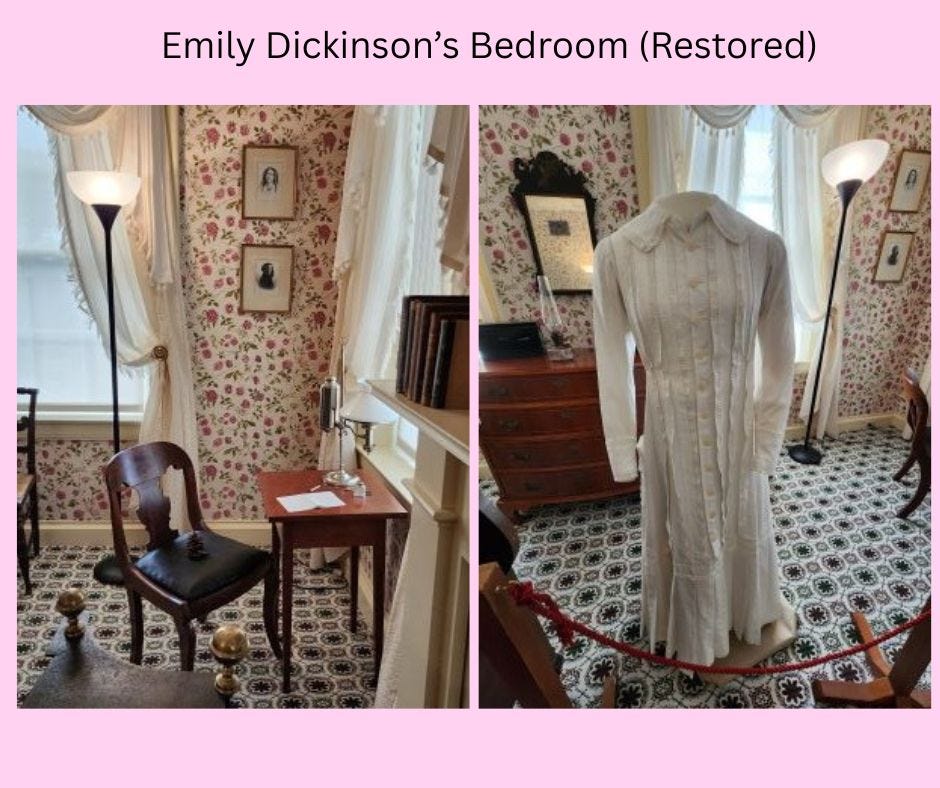
The passionate guide urged me onward with family stories culminating in the journey of a few steps upstairs to her inner sanctum. A replica of her writing desk (the original sits at Harvard) contemplates The Evergreens, a walk across the lawn to her best friend’s home.
Emily’s muses, in portrait form, stand guard above her desk as she pencils or pens thoughts into words. Elizabeth Barrett Browning and Mary Ann Evans (pen name; George Eliot) influenced the poet, she professed in her correspondence, even as she crafted three elegies in Browning’s honor.
I thought about how small Dickinson’s outer world truly was. She seldom left Amherst, seldom socialized with anyone but her family, and attended college for only one year to retreat back to The Homestead with family, a cloistered garden, and a greenhouse to keep her company. By the time she’s in her twenties, she notes her differences from others of her time, and “selects her own society” as her poem tells us, spending more time secluded in her bedroom.
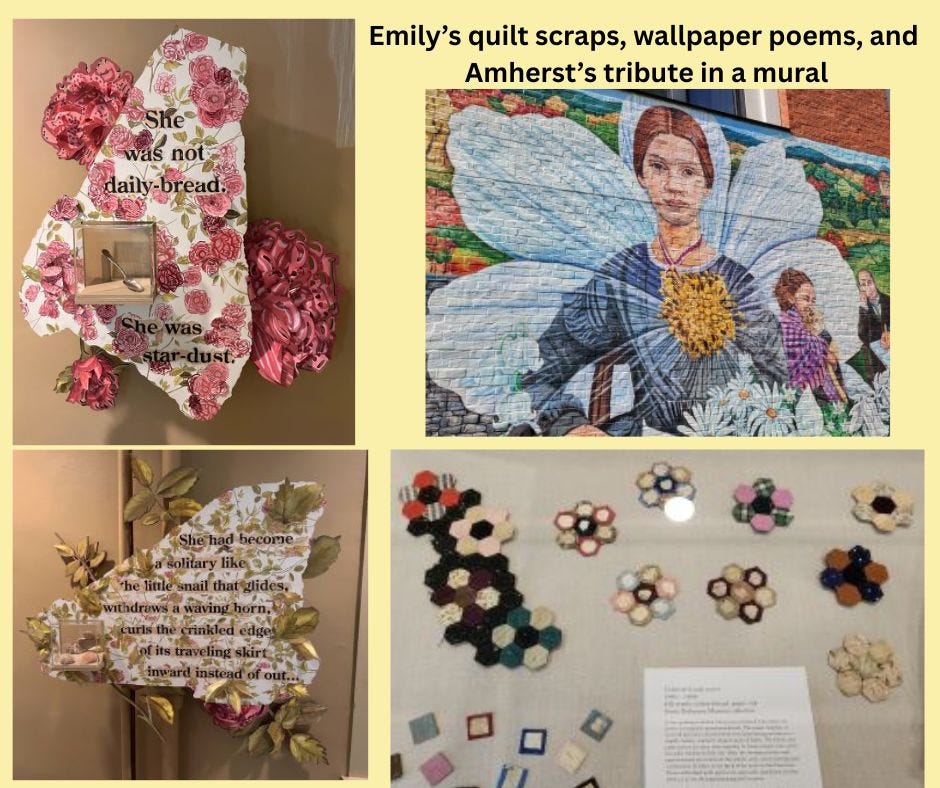
As Dickinson’s outer world contracted, her inner world blossomed and the outpourings of her creative intellect spilled onto paper, envelopes, and even chocolate wrappers. Some small poems were discovered on quilting scraps while a multitude were inserted into the thousand letters she wrote.
In Poetry Slammed, Vivian’s inner and outer worlds mimic Dickinson’s to an extent. While the poet kept her afflictions mostly private, Vivian carries her pain around in several tote bags, representing what matters most to her in the world. Yet Vivian is passionate about poetry, igniting the power of words and rhythm through her college courses and open mic performance nights on campus.
Maybe the epitome of Dickinson’s simple outer world is the iconic white dress she often wore. Much has been written about her wearing white, but the idea of her being some sort of spectral vision or spinster yearning for marriage has been replaced by a sensible explanation.
The Homestead guide tells visitors the poet requested a house dress, loose-fitting, comfortable, with pockets so she could always carry a pencil or pen with her. The white dress was an act of rebellion for the time. It allowed Dickinson to dress without a corset for starters. Even more clever on her part, she would not be expected to entertain guests in a garment considered a dressing gown. The infamous white dress was perhaps more symbolic of Dickinson’s freedom to do as she pleased than a token of her eccentricity.
I enjoyed the Emily Dickinson revealed through touring her home in Amherst and reading the short biography written by her niece, Martha, filled with personal peeks into the poet’s daily life. I find Dickinson still reveals and conceals herself every time I encounter one of her nearly eighteen hundred poems. The fact she remains a mystery made her an irresistible choice for me, and a daring one, too. It takes audacity to be an author. Moreover, it takes an expansive inner world, no matter how minuscule or basic one’s outer world appears.
Advice for cultivating a broad inner world: Read a lot and often. Watch programs that transport you to other places, other time periods, and beyond our world. Listen more than you speak. When you learn the stories of others, your inner world grows.
Joy Ann Ribar is an RV author, writing on the road wherever her husband and their Winnebago View wanders. Joy’s cocktail of careers includes news reporter, paralegal, English educator, and aquaponics greenhouse technician, all of which prove useful in penning mysteries. She loves to bake, read, research wines, and explore nature. Joy’s writing is inspired by Wisconsin’s four distinct seasons, natural beauty, and kind-hearted, but sometimes quirky, people. Joy holds a BA in Journalism from UW-Madison and an MS in Education from UW-Oshkosh. Two of her Deep Lakes mysteries were recognized by Chanticleer Cozy and Not-So-Cozy mystery awards. The Medusa Murders received 2nd Place in the Book Fest awards for Women’s Fiction/Mystery. You can visit her website, www.joyribar.com, and buy her books on the Blackbird Writers site.
Dickinson's handwriting is as enigmatic as she was, with oceans of space between the islands of words. It points to her solitude, which became a fear of contact with others.
Quite a profound post, full of insight and wisdom. I think Emily herself would approve of your treatment of her.